

How to See an Atom
Atoms are a thousand times smaller than what an ordinary microscope can show. Scientists figured out how to see them anyway: not by looking, but by feeling with a thin needle. Try it yourself — in the “Black Box” experiment.
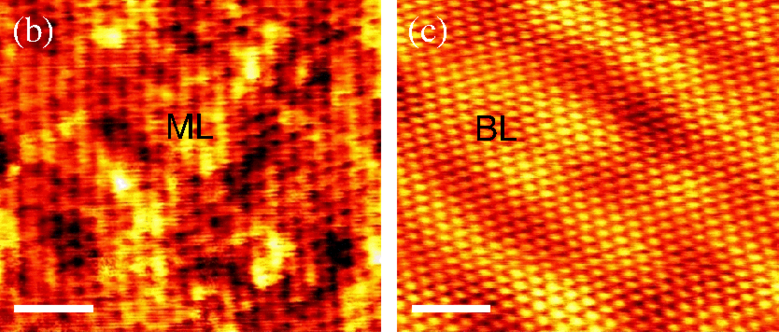
Everything around you — water, air, your desk, and you yourself — is made of . Atoms are very small. If you lined up a million atoms in a row, the chain would be shorter than a millimeter.
Scientists measure such tiny things in . A nanometer is as many times smaller than a meter as a coin is smaller than the whole Earth. A hair's thickness is about 80,000 nanometers, and an atom is smaller than one nanometer.
Why an ordinary microscope can't do it
An ordinary microscope works with light. Light is a wave, and it has a length: for visible light, roughly from 400 to 700 nanometers. Details smaller than about 200 nanometers blur into a single spot. It's like drawing thin lines with a thick brush: no matter how hard you try, you can't draw anything thinner than the brush.
An atom is about a thousand times smaller than this limit. So you can't make it out with light, no matter what lenses you use.
The idea: don't look, feel
Imagine you're in a dark room. Your eyes won't help, but you can touch an object and figure out its shape. That's how blind people read books: with their fingers over the raised dots of Braille. The Nobel Committee compared the new microscope to Braille when it presented the prize to its inventors in 1986.
A microscope feels a surface with a very sharp needle — a probe. Its tip ends in just a few atoms. The needle passes over the surface line by line, and at each point the computer records the height and then draws a picture from these numbers.

The colors in such images are invented by the computer. Usually light means “higher” and dark means “lower.” The atoms themselves aren't orange or blue: they have no color at all in the usual sense.
Black Box: Become a Probe Microscope
An adult is needed
You will need
- A shoebox with a lid
- 3–4 small objects: a cube, a jar lid, a toy, or clay figures
- Glue or tape
- A wooden stick with a blunt end (for example, a sushi stick or a pencil)
- A ruler
- A sheet of graph paper and colored pencils
What to do
- Ask an adult to glue the objects to the bottom of the box — so that you can't see what's inside.
- The adult makes even rows of holes in the lid, 2 centimeters apart, and closes the box.
- Lower the stick straight down into each hole until it stops.
- Mark with your finger how far the stick went in, and measure it with the ruler.
- Write the number in a square on the paper: one square is one hole.
- Color the squares: where the stick stopped high, use a light color; where it went deep, use a dark one.
- Use your picture to guess what's in the box, then open it and compare.
What is happening
You worked as a probe microscope. The stick is the needle, your hand is the sensor, and the graph paper is the computer screen. The closer together the holes are, the more detailed the picture. A real microscope does the same thing, only its needle is hundreds of thousands of times sharper, and it measures tens and hundreds of thousands of points.
Be careful: Only an adult should make the holes in the lid — with an awl or a thick nail. The stick must have a blunt end: don't wave it around or point it at anyone's face. Keep small parts away from little children — they can swallow them.
The “Black Box” experiment is adapted from the Mystery Shapes activity of the NISE Network (CC BY-NC-SA 3.0 US). Our version of the experiment is distributed under the CC BY-NC-SA 4.0 license.
Sources
- Десять в минус девятой: популярно о нанотехнологиях — «Элементы» («Популярная механика») (Retold with a link)
- Just How Small Is Nano? — National Nanotechnology Initiative (США) (Public domain)
- The Nobel Prize in Physics 1986 — пресс-релиз — Nobel Prize Outreach (Retold with a link)
- NISE Network: NanoDays, Exploring Tools — Mystery Shapes — NISE Network, Sciencenter (CC BY-NC-SA)
- Graphene STM.png — Kendal W. Clark et al. (CC BY)
- Graphite ambient STM.jpg — Frank Trixler, Ludwig-Maximilians-Universität München (LMU); adapted from LMU/CeNS: Organic Semiconductor Group (Public domain)


 I’m offended. Let’s talk tomorrow.