

Tiny crystals assemble into zebra-like stripes
Researchers at Cornell University have discovered how to control patterns made of quantum dots. As liquid evaporates, these tiny crystals leave behind stripes, ribbons, and other patterns.
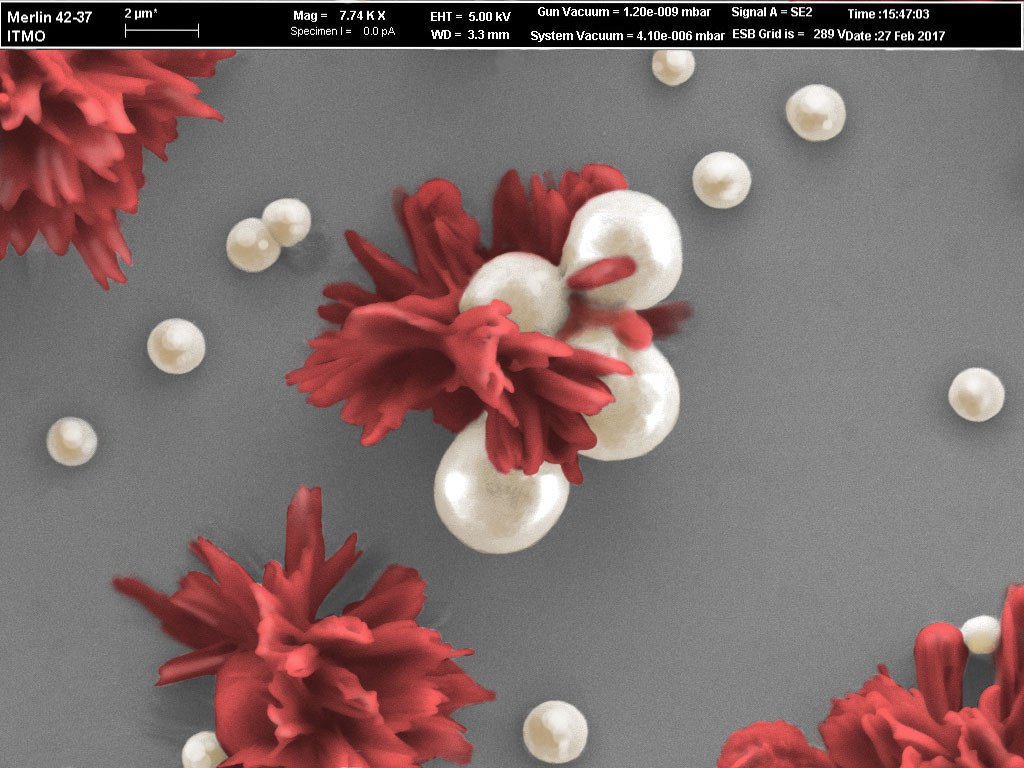
Photo: Elena Ushakova, CC BY, Wikimedia Commons
Zebra stripes can be seen beyond the animal world. Researchers at Cornell University observed similar patterns in drying droplets containing tiny . These crystals are called quantum dots. The resulting stripes looked like the markings of zebras and tigers. But the physical causes behind these patterns are very different.
For the experiment, the scientists took very small droplets of liquid containing quantum dots and watched them under a microscope. As the liquid evaporated, the droplets shrank. A thin film with various patterns remained in their place. Each quantum dot contained about a thousand —the tiny particles that make up matter. The researchers examined small clusters of about twenty of these dots.
It turned out that the pattern could be changed in two ways: by adding more or fewer particles to the liquid and by adjusting how quickly it evaporated. During slow drying, the patterns appeared in a specific sequence. First came areas with several layers and areas with a single layer, followed by holes, ribbons, and tiles. A computer calculation reproduced the same sequence that the scientists observed in the experiment.
The work helps explain how to control the assembly of tiny particles into desired structures. In the future, this kind of control could be useful for creating devices that work with light and electronic devices. These could be assembled from building blocks similar to those studied in the experiment.
Related lessons
Sources
- Наночастицы оставляют узоры, похожие на полосы зебры — Phys.org (Retold with a link)
- Наноструктуры "Гвоздики с жемчугом".jpg — Elena Ushakova (CC BY)


 I’m offended. Let’s talk tomorrow.