

Robots get soft “antennae” that tell gases apart and sense wind
Scientists in China have created two soft “antennae” for robots. They tell gases apart while also measuring wind speed and direction.
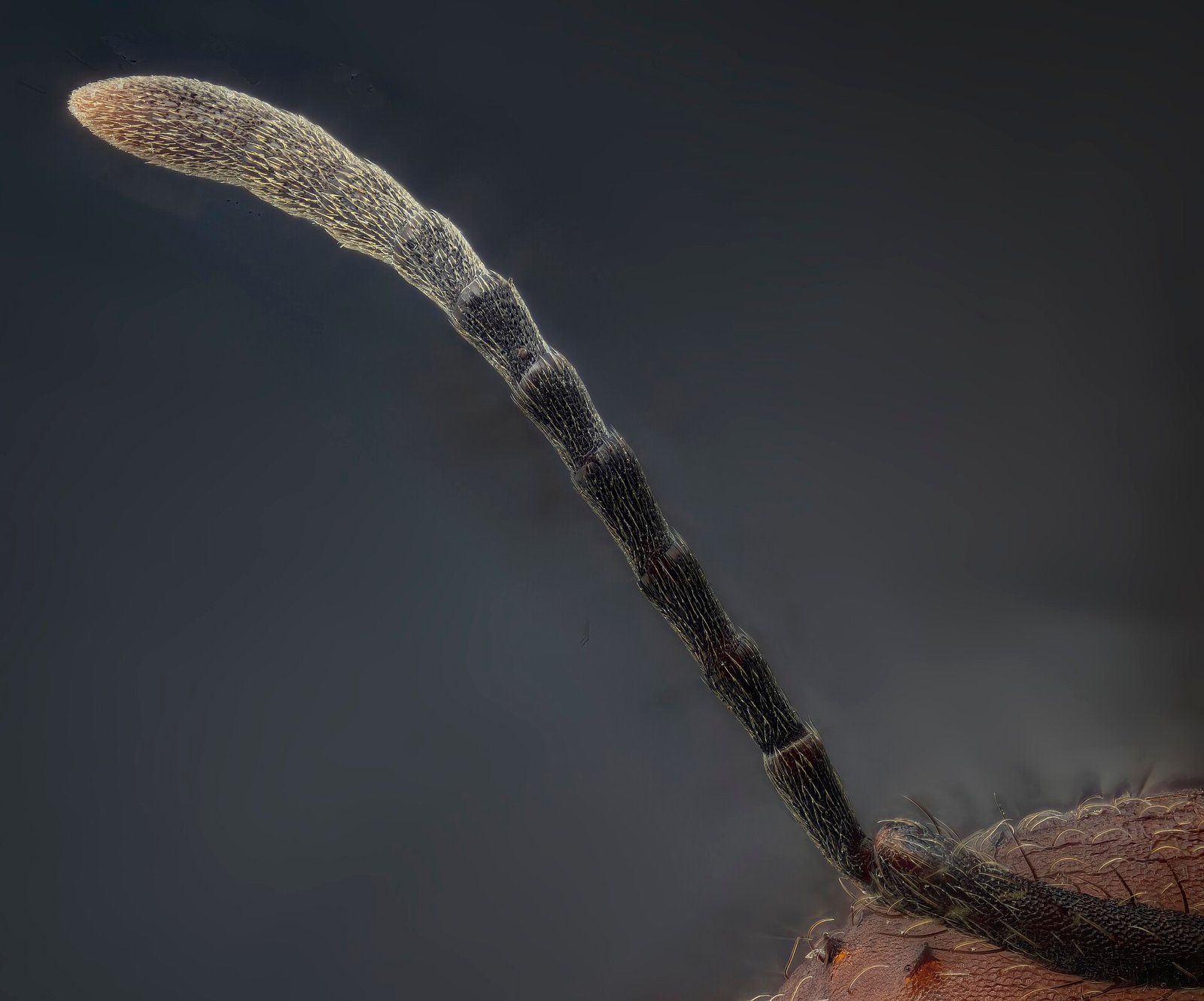
Photo: Fedaro, CC BY-SA, Wikimedia Commons
Researchers at two Chinese universities—South China Normal University and South China University of Technology—created fibers that resemble an ant’s antennae. They made them from a hydrogel—a soft material that holds water. Light travels through the fibers. Two of these “antennae” were mounted on a mobile robotic platform to test for gas and air movement at the same time.
Each “antenna” produces two different signals. When wind bends the fiber, the light inside it grows weaker. Its surface also has metal-organic frameworks—crystalline materials with many tiny pores. Under special lighting, they glow. Different gases change the brightness and color of this glow. A computer program processes both signals and helps determine which gas is nearby and how the air is moving.
Two fibers with eight types of coatings told 16 gases apart with 98.5% accuracy. When the system measured gas and wind at the same time, its accuracy dropped by less than 1%. This is how the researchers tested how well the “antennae” could handle two tasks at once.
They then carried out 50 experiments in a chamber 3 meters wide and 2 meters tall. In trials set aside for testing, the system located the point where a gas mixture was released with an average error of about 9 centimeters. It correctly identified all the mixtures. But the researchers have not yet shown the robot moving to the gas source on its own.
Sources
- Роботам сделали «усики», которые чувствуют запахи и ветер — Nanowerk (Retold with a link)
- Ant antenna.jpg — Fedaro (CC BY-SA)


 I’m offended. Let’s talk tomorrow.