

Grades 9–11 4 min
How Atoms Hold Together
Attraction and repulsion between atoms, chemical bonds, and weak forces between molecules, and why carbon alone can form diamond, graphite, graphene, fullerenes, and nanotubes.
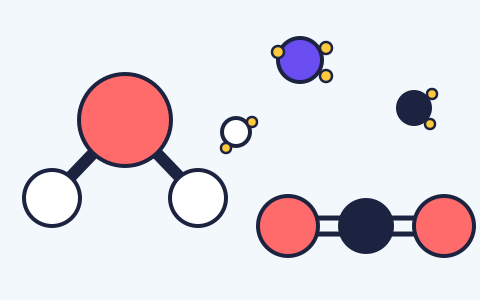
are held together by electric forces: the electrons of one atom are attracted to the nuclei of neighboring atoms. While two atoms are far apart, they barely notice each other. As they come closer, attraction appears. But if they are brought too close, their electron shells begin to repel each other sharply. Between these extremes there is a favorable distance: the bond length. It is a few tenths of a . Neighboring carbon atoms in diamond are 0.154 nm apart, and neighboring in a salt are about 0.28 nm apart.
What Kinds of Bonds Are There
- Covalent bond: neighboring atoms share pairs of electrons. This is how the water and the diamond crystal are built.\n- Ionic bond: one atom gives an electron to another, and the oppositely charged ions attract each other. This is how a crystal of table salt holds together.\n- Weak intermolecular (van der Waals) forces: they are much weaker than chemical bonds, but they act between any molecules and surfaces. Together with other forces, it is these that the ’s needle “feels.”
One Element, Many Substances
Carbon forms many different structures, which are called allotropic modifications.\n\n- Diamond: each atom is covalently bonded to four neighbors, and the bonds form a strong three-dimensional network. It is the hardest natural mineral, and it does not conduct electricity.\n- : each atom is bonded to three neighbors in a flat layer of hexagons. Within a layer the bonds are strong, but between layers they are weak, so the layers easily separate. Graphite conducts electricity along its layers.\n- : a single layer of graphite, one atom thick. Andre Geim and Konstantin Novoselov obtained it by peeling layers off a piece of graphite with ordinary Scotch tape. In 2010 they became Nobel Prize laureates in physics.\n- C₆₀: a hollow molecule of 60 atoms, shaped like a soccer ball. Fullerenes were discovered in 1985, and in 1996 the discovery was awarded the Nobel Prize in chemistry.\n- : a layer of graphene rolled into a cylinder, with a diameter from half a nanometer to several nanometers.

Read more
Play and try
Sources
- Atomic force microscopy — Авторы Википедии (CC BY-SA)
- Sodium chloride — Авторы Википедии (CC BY-SA)
- «Нанотехнология», «нанонаука» и «нанообъекты»: что значит «нано»? — Л. Б. Пиотровский, Е. А. Кац («Экология и жизнь», на сайте «Элементы») (Retold with a link)
- Allotropes of carbon — Авторы Википедии (CC BY-SA)
- The Nobel Prize in Physics 2010 — пресс-релиз — Nobel Prize Outreach (Retold with a link)
- Sodium-chloride-3D-ionic.png — Benjah-bmm27 (talk · contribs) (Public domain)
- Eight Allotropes of Carbon.png — Created by Michael Ströck (mstroeck) (CC BY-SA)


 I’m offended. Let’s talk tomorrow.